Showing posts with label artist entry. Show all posts

Monday, April 5, 2010

Artist Entry: Olafur Eliasson

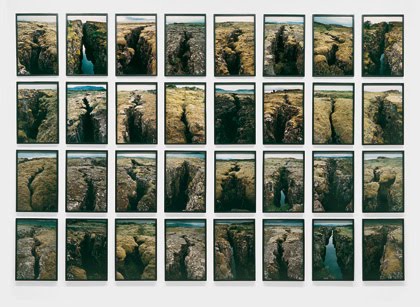
Olafur Eliasson is an artist from Copenhagen, Denmark whose work is primarily sculptural. However, it seems that each year there is one type of project he installs - and that project is what caught my attention. The pieces are a series of various natural geological/ecological structures/occurrences. Perhaps it is just my geology class that is turning me into an even bigger environmental nerd but regardless, its fascinating to see how these places in nature exist in a similar fashion, yet are so different and individual.

His presentation is something to be admired (and to take into consideration as to how I decide to present my piece). Viewing his work has certainly put some fire under my bum to dive back into my work (after my brief hiatus).

Another thing I admire about all his work is its dependance and existence based off of its contained environment, which becomes fairly evident upon looking at his work. In 1996, he installed a series of images depicting waterfalls. Then, in 2008 he installed waterfalls in New York City locations. Not only do the who pieces reflect on each other in subject matter but also their purpose. They bring the natural into a space where its often forgotten and certainly not seen. Its a reminder of what else is there and its power.

I could go on and speak about each one of his pieces, discussing why they are so important and profound but I won't. I think I've found (one of) my new favorite artists! Below I have included the various series that I discussed above, as well as a few installation pieces.


All images are (c) to Olafur Eliasson & were found via Google Image search.

Sunday, March 28, 2010

Artist Entry: Patrick O'Hare

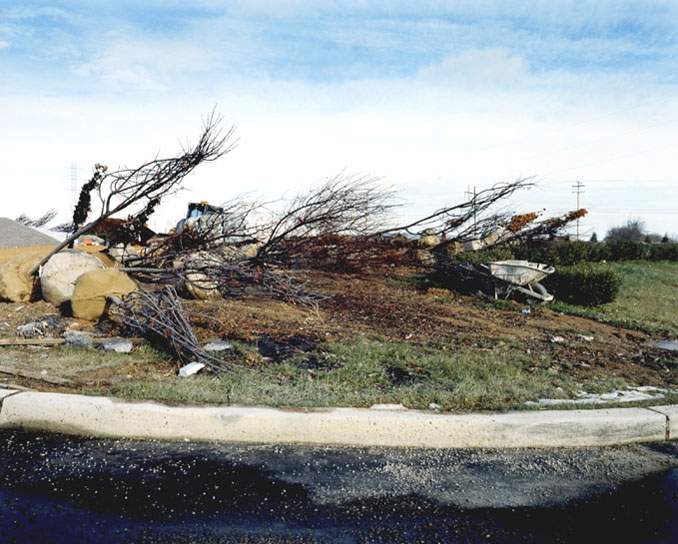
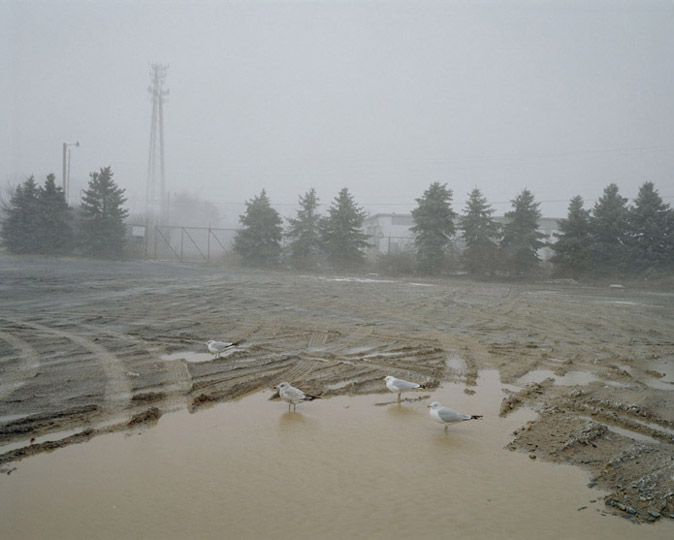
Patrick O'Hare is an admirable photographer who's imagery focuses around disturbed landscapes. The land is in a state of upset primarily due to human interference. He has three series displayed on his website which are Slipstream, Learning to Vanish, and The Silence Between Stations. In all three, I can see similarities between our concepts however he has somehow managed to capture it in multiple images in various locations which vary in subjects...all the while, maintaining the concept. I admire this because I feel like if I veer off too much from my methodology then my concept will be lost. I think that O'Hare is an excellent example of successfully doing so.

Furthermore, in a statement about his series Slipstream, O'Hare uses the word impermanence, which is one word that was in my statement/defined last week. In regards to his work, I think it fits more so than it does with mine. Anyway, in his book featuring Slipstream, he says:

"Slipstream is a personal exploration of ravaged landscape glossed over and sealed by perpetual development and at the same time, more vulnerable than ever to man made and natural upheavals. It Visually lays open a culture of impermanence, architecture of the fleeting and the sense of a rootless world that could easily be swept away. [...] The physical effects of these forces can be seen on most any street, highway, or mall. Our lives are played out against these backdrops as well as quiet hope and desperation. But it is here also, in the everyday, where mystery still resides and the ruins of our civilization still haunt us. My goal is to photograph the silent truths of an uncertain age: those places on the edge of a frayed world."


Wednesday, March 17, 2010

Artist Entry: Allan Mccollum


Allan McCollum is a multimedia artist who currently resides in New York City. His work deals with "how objects achieve public and personal meaning in a world constituted in mass production, focusing most recently on collaborations with small community historical society museums in different parts of the world" (Source). I was drawn to his work because of the organic nature of his structures, which is good because that is what he (I believe) is interested in. Though they look the same even though some vary in color, the overall project speaks of the unique nature of identical object. Nature nor man can make one object exactly the same. I wanted to find out more information about his pieces but oddly enough couldn't find too much more. I did however find this video. In one of McCollum's pieces, he outsourced work to a family owned company in Maine to help in creating his final piece. The video can be seen below:

Sunday, February 28, 2010

Artist Entry: Bryan Nash Gill

Bryan Nash Gill is a sculptor out of Connecticut who works with natural materials to create two dimensional and three dimensional pieces. While all of his work is aesthetically and conceptually strong, the pieces I am drawn to the most are his two-dimensional relief prints that he creates from copying the rings on tree stumps. From his website, "Pat Rosoff an art critic for the Hartford Advocate wrote 'Bryan Nash Gill is not simply a naturalist, he is an artist rooted in nature he draws his vocabulary from the world of New England's woods.'"

I am really happy I found his work because not only are his relief prints simular to what I am currently working on, but his instillations are moving and do what I am trying to express. The beauty of nature is powerful, and if art galleries are where some people go to be moved, then nature has a place there. His various presentations of nature in the gallery space depends on not only the pieces but it seems the materials used as well. Also, I am falling in love with my project because I am responding to his prints. An article about his work said:
"For good reason, environmentalists are up in arms over rain forests being bulldozed for their timber value, one of the earth's greatest biological treasures left carved down to sad little stumps. If I were to play devil's advocate, I'd call up Bryan Nash Gill, who has translated a dismal tree stump into something beautiful. Through relief printing and a laborious rubbing technique, Bryan created the print Hemlock 82 ($4,000), essentially a manual Xerox of the gorgeous growth rings of one section of a tree. To do so, he rolls ink out onto the stump and places a piece of hand-crafted Washi paper onto the "print block." Then, he presses the paper with his fingertips little by little, imprinting the texture of the wood onto the surface of the paper. Jaw-droppingly beautiful. I love the idea that something dead can be given a new life with this technique — or a dozen lives, seeing as it's a limited-edition of 12" (Source).


Monday, February 22, 2010

Artist Entry: Susan Derges

At first glance, one might think that Susan Derges pieces are created by shooting reflections in a pool of water -- or in some other cases, through a microscope. But the truth behind her imagery is even more exciting. If one is told these images were not created using a camera, they might be led to believe they are paintings with the softness and surreality. Derges did train in painting originally, which could explain how and why she turned to such a hands on approach to photography. Her images are produced by three major elements: water, light and sound. In some series' she does photograms and in others she allows the paper to record images through ambient light exposure. "Her images, though based upon the capturing of external natural realities, take on a metaphorical dimension that echo the inner life of the unconscious and imaginative" (Source).

Her work is so inspiring and I feel as if I could spend hours just staring at the images trying to figure out how something so beautiful was created, especially in the methods through which she does them. I found her website difficult to navigate because every time I'd read something the mouse would move and I'd have to find where I was so unfortunately I was only able to read reviews of other reviews and unable to obtain very many quotes. However, here is one:
The images look - in the same way as some of the spawn images did - quite microscopic at times, as if you are looking from a very extreme aerial view down onto the landscape. There is also a very strong sense that you are placed underneath and that is certainly a lot to do with the effect of working with photograms, that the actual event is happening where the subject matter meets the paper, which is always from the underside of the subject matter rather than from above when you are working with a camera (Source)


Monday, February 15, 2010

Artist Entry: Nikki Graziano

Nikki Graziano is young, very intelligent and very successful in understanding and creating meaningful photographs. Her series that I am particularly interested in is, Found Functions. I honestly cannot remember how it is I stumbled across her artwork but I was very pleased when I did.

Graziano is a student at Rochester Institute of Technology, who has already been blogged by dozens of different websites for this series in particular. She calls herself a photographer and a mathematician but its her clever way of blending her two "selves" that caught my interest.

Also, her images are almost simplifying and attempting to find an understanding of nature's, well...function. And really, thats what her images mean to me -- a glimpse into the mind of scientists trying to understand nature...yet, the equations are so complex that it speaks about the complexity of nature itself.

In explaining her process, she said she "whips up the numbers and tweaks the function until the graph it describes aligns perfectly with the photograph" (Source). Therefore, none of her photos are lies, none of them are coincidental to fitting an found equation -- she actually works everything together.

I've recently become a pretty big Tumblr fan but have restricted my posting because I feel pretty silly when I do. However, I am following a few artists and Graziano is one of them. From there, I was able to pull quotes of her speaking about her work. Other than that, it's been pretty difficult to find more in-depth reporting about her work, which is a shame.

Q: As a mathmatician and an artist, how do you think is the best way to mix both your passions?

A: I don’t really think there’s much of a disconnect between the two (not when you think of the disciplines as two disciplines, rather than how our culture treats them), so I don’t really think it’s too hard to to both.

Q: Why are you obsessed with math? I know it's beautiful and all, but in the end it doesn't solve anything. Life isn't an equation. There are too many variables. You can not solve it, you can only observe and feel.

A: precisely. (the last part)

(Source)


Monday, February 8, 2010

Artist Entry: Barry Underwood

Barry Underwood is a photographer who creates illusions and draws attention to the natural beauty of landscape. His light work instillations are created onsite around and within the natural environments. In his statement, he expresses his goal and approach in creating his imagery:
I use these as the means to explore issues of illusion, imaginations, narrative and the potential of the ordinary. I approach my photographic work with a theatrical sensibility that permits me to intermingle issues that arise from contemporary painting, cinema and land art. The resulting images are surreal imaes, given that they result from the cross-pollination between traditional photography and theater. Light and color are used as subjective tools, affecting the perception of space while defamiliarizing common objects. IN this work, therefore, illusionistic space collapses while the lights that I install appear as intrusions and interventions as they contrast with the inherent atmospheric properties of natural light. This combination renters the forms in the landscape abstract. (Source)
I feel a connection to his work because he is accentuating the natural beauty and creating alternate realities within them. The images that he creates somehow manage to trick the viewer, in the sense that, when viewing his work, I think that perhaps these events have actually occurred or do occur in nature but that they are not seen by us, only the plants and animals within the environment. In my previous work, I used light to accentuate "pain" in the environment and its a direction that I intend to continue with, however this idea of using light (especially colorful light) is a new avenue I find interesting. In a review of Underwood's work, Gizmodo said "The glowing elements that should jar our eyes as electrical protrusions actually serve to capture nature with a new thesis: as a planet intrinsically altered by our footprint, though, not in that we've destroyed our Earth and things are too late kind of way." (Source)


Monday, February 1, 2010

Artist Entry: Kevin Newark

I first encountered Kevin Newark's work last spring at the New York Photo Festival in Brooklyn. His work Protoplasm was showing and upon first glance, you would think you were looking into a microscope at an organism or through a telescope into space. However, his images are old, used trash bags in water. In an interview at the festival, Newarks says:
"Their spent utility a metaphor for our own mortal anxiety. [...] For me photography is a device for extending the visual experience, while also transforming the subject. A delay in cognition produces a kind of disorientation, which I’m quite interested in exploring. Perception and surface play an important role in my photography.” (Source)
On the Facebook event page, they describe Newark's series as "look[ing] to find solace for the exiled soul of the plastic bag." I feel like he is an important artist for me to report on not only because his work touches on environmental issues (whether or not he intends to, I haven't discovered) but because he is animating the inanimate. The photographs go deeper than what's in front of you, without the use of text and without being so literal. He does not have a website and the only information I can gather is from interviews with him. However, I think his quotes speak volumes about his work and indicate each photograph is completely intentional. His observation and concept influenced his execution.


Sunday, November 15, 2009

Artist Entry: Anne W. Brigman

I am really excited about my artist tonight. Its unfortunate I hadn't been exposed to her work before because our visions are so similar. She was not only one of the first women photographers but one of the first photographers in general to use the camera as an artistic tool creating something called "ecofeminism," according to Intimate Circles. Her images were of women in nature in dramatic poses reaching towards something, as if growing out of the tree. She manipulated her negatives by layering and disturbing their surface. The "female nude in nature" is over-saturated now but at the time it was risky and contemporary. My favorite interpretation from her images is from The Photo Book where the writer was speaking about her piece The Soul of the Blasted Pine.
"She is probably a hamadryad or Classical tree nymph who is suffering the bad fortunes of her host in the mountains of California. According to the old stories, hamadryads were tree spirits and they died when their trees decayed."

"She [Brigman] described the trees of the Sierras as 'squat giants twisted and torn with the sweep of the prevailing winds' [...] she could visualize 'the human form as a part of tree and rock rhythms.'"

I was interested in finding out what ecofeminism meant (even though I do not only portray females). According to Wikipedia, ecofeminism highlights the correlation between the oppression of women in society and oppression of nature by man. The exact definition is as follows:
Ecofeminists argue that a strong parallel exists between the oppression and subordination of women in families and society and the degradation of nature through the construction of differences into conceptual binaries and ideological hierarchies that allow a systematic, however logically unsound, justification of domination ("power-over power") by subjects classed into higher-ranking categories over objects classed into lower-ranking categories (e.g. man over woman, culture over nature, white over black.
The Soul of the Blasted Pine


I hate to say it because I always jinx myself but I think I'm getting closer now to finally being happy with my project.

Monday, November 9, 2009

Artist Entry: Sarah Moon

Sarah Moon's photography has such a wide range of subjects and styles. I came across her work in the Photo Book which led me to believe that I could and should jazz up my images if they are going to be something I care about. Looking at her imagery, you get lost in the aesthetic quality but only second to the bizarre subject matter. You get a sense of loss or loneliness. Also, her images are heavily staged and you can distinctly tell its fabricated reality. You can spend time with her imagery and read more and more into it. With her piece depicting the tea party where the dignified man is a cat, you begin to read more and more into it. Same with the image of the pony walking onto the white sheet. Her fabricated realities often use large blocks of fabric color, which I am thinking about incorporating into my pieces.

Sarah Moon was born with the name Marielle Hadengue in England around the late 1930s. She said, "To be more creative is to get closer to childhood." (Source)


Monday, November 2, 2009

Artist Entry: Mark Dion

I chose to write about Mark Dion not only because he is one of my favorite artists ever but because his work is extremely relevant to what I am creating this semester. Dion is an artist, collector, archeologist and environmentalist. It also "
examines the ways in which dominant ideologies and public institutions shape our understanding of history, knowledge, and the natural world" (Source). Two pieces I am primarily focusing on are Mobile Bio-Type Jungle and Neukom Vivarium, both environmental, heavily researched pieces where natures beauty, story and the biography of the specimen is the real work of art.

Mobile Bio-Type Jungle is a mixed media piece made in 2002. It is nearly impossible to find any information about the piece itself because most of what Dion is known for (according to the internet) is Neukom Vivarium. However, Bio-Type like most of his work comments on the power of nature versus the growing popularity of science. I've been struggling on incorporating my distain for science into my art this semester but have realized that aspect doesn't necessarily have to be brought up if the rest of my work speaks strongly enough, like Dion's.


Neukom Vivarium

Mobile Bio-Type Jungle

Neukom Vivarium was hands down my favorite. Before I knew what he was about, I was aggravated when I saw the piece because what so many "natural" artists do is pick up nature and put it in a gallery but then they don't think about how they are DISRUPTING nature by doing this! What do you do with the leaves, vines, bark-whatever, after you use it? Throw it away? The collection of my 'tree parts' has only been from already fallen pieces of the tree, I'd like to note. I also am sure to examine each piece before I remove it to ensure it is not a home to any living creature. Before I get off on a tangent though, I will go back to why after hearing him talk about his process on this project, I was so moved by his work. In this project he 'rescued' a fallen tree and worked with a large team to develop a way in which every species using that tree as a home can continue to survive. He built housing for the tree which acts as its own environmentally controlled room with shades, vents, heat, rain-whatever the tree needs to continue to survive.

Overall, his work's message is where I am trying to get mine to be. The beauty, wonder and power of nature is overwhelming and it deserves to be honored like any other famous painting, sculpture, whatever. Also, the experience as the artist creating the work is something of art in and of itself - the methodology in which I have begun to research, collect, gather, photograph, assemble.

Me attempting to speak about his work doesn't necessarily do it justice so I have included some of his quotes from an interview on Art:21 to give a better description of exactly what he is trying to say, that I feel relates 100% to what I am trying, so hard, to say also.

"I think that one of the important things about this work is that it’s really not an intensely positive, back-to-nature kind of experience. In some ways, this project is an abomination. We’re taking a tree that is an ecosystem—a dead tree, but a living system—and we are re-contextualizing it and taking it to another site. We’re putting it in a sort of Sleeping Beauty coffin, a greenhouse we’re building around it. And we’re pumping it up with a life support system—an incredibly complex system of air, humidity, water, and soil enhancement—to keep it going. All those things are substituting what nature does—emphasizing how, once that’s gone, it’s incredibly difficult, expensive, and technological to approximate that system—to take this tree and to build the next generation of forests on it. So this piece is in some way perverse. It shows that, despite all of our technology and money, when we destroy a natural system it’s virtually impossible to get it back. In a sense we’re building a failure."

"I’m interested in thinking about nature as a process. So this isn’t really about the tree, even though the tree is the superstar. It’s really about what’s happening to the tree, about the process of decay. We shouldn’t really feel particularly bound up in the demise of this tree because on this tree is the basis of the next forest. The tree supports a living bio-system, from single-cell organisms all the way up to vertebrates—mice, shrews, and birds. I want this piece to talk to the audience, but not necessarily spoon-feed them or give them what they want. I want to acknowledge or even enhance the uncanniness of nature—the wonder of the vast complexity and diversity within a natural system."

"I’m not sure there is a really succinct way to talk about how this piece politically engages people. In a sense, what I’m doing is bringing a forgotten element of the environment back into the city. I’m taking something that would have existed on that site a long time ago and returning it to that site. But at the same time I’m building a cultural framework around it."

"In some way I want to acknowledge or even enhance the uncanniness of nature and the wonder of the vast complexity and diversity within a natural system. I want to show how difficult it is for us to grasp—not just conceptually, but also practically. How difficult it is for us to figure in all of the variables that you would need to replicate a forest. We’re trying but we can never do it perfectly. That’s one of the most interesting aspects of the piece for me."

"The movement away from superstition and tribalism is an incredibly important factor in the future of our relationship with the planet."

"I think it’s important that the category of nature is not something the field of science has a monopoly on, that everyone has a say in what gets to be nature at a particular time for a particular group of people."

Monday, October 26, 2009

Artist Entry: Keith Arnatt

Keith Arnatt (1930-2008) was an artist from England who's work varies from sculptural to photographic to a combination of the two. The pieces I was drawn to the most were his Self-Burial photographs.


The message that I took from the images were those that would apply to my work though his intention wasn't necessarily similar at all. He says, that his work became about "difficulty of being an artist at that time. The formal vocabulary had become exhausted." The formal vocabulary he was referring to applied to painting, which his friend, teacher and fellow artist David Hurn said that Arnatt's work was emerging from. Hurn said that, Arnatt was "always referring something back to paint and he would pick the kind of light to allow reference to those paintings."
Arnatt's work appears to have been created in the 70s (I say this because of the quality of the image looks like much of 70s photography) and that is when his Self-burial series was primarily exhibited. However, he felt he didn't 'know how' to take pictures and wanted to learn. One of the primary reasons I chose Arnatt to reference was because of his wide-span of artistic range. I admire his ability to be an artist first and photographer second. His work upon investigation isn't necessarily light-hearted though it may appear that way at first.
Admittedly, I found his work to be visually appealing and that is why I first started researching him but soon discovered he was a master of concept. His work is "highly intelligent and [he] wrote these conceptual pieces that were witty and profound, but put it into pictures in a way the general public can understand" whether or not they spend a few moments with it or a few hours.
Personally, I feel torn. As an artist, I can related to Arnatt's statement: "I don't have the motives and never have had the motives that other people have for using the camera." But I think that side of me has only developed as I've been in art school. I use the camera as a tool in place of my hand because I fail miserably as an illustrator and I like the results. But as the businesswoman and journalist, I feel that my motives to use the camera are intentional: to communicate certain information accurately. I think for my senior portfolio, I have found a way to merge these two sides by providing a piece that is very research and interview based as well as makes a comment on our state of things (also applying locally instead of taking on an international level) but also includes my 'camera paintings.'
On a final note, I found so many good quotes from him that I wanted to include this one, about his - well probably 99% of artists - process: You start and idea which brings a result, something might happen or you might see something in it which seems to depart from something you originally meant and so on. Its the eternal fascination.

More of his work:
Notes from his wife...I love this. Their relationship was beautiful and comical.